BUY (internationally) ; BUY (from your LOCAL retailers)
Please contact editor@ayeina.com for BULK ORDERS (15 or more)
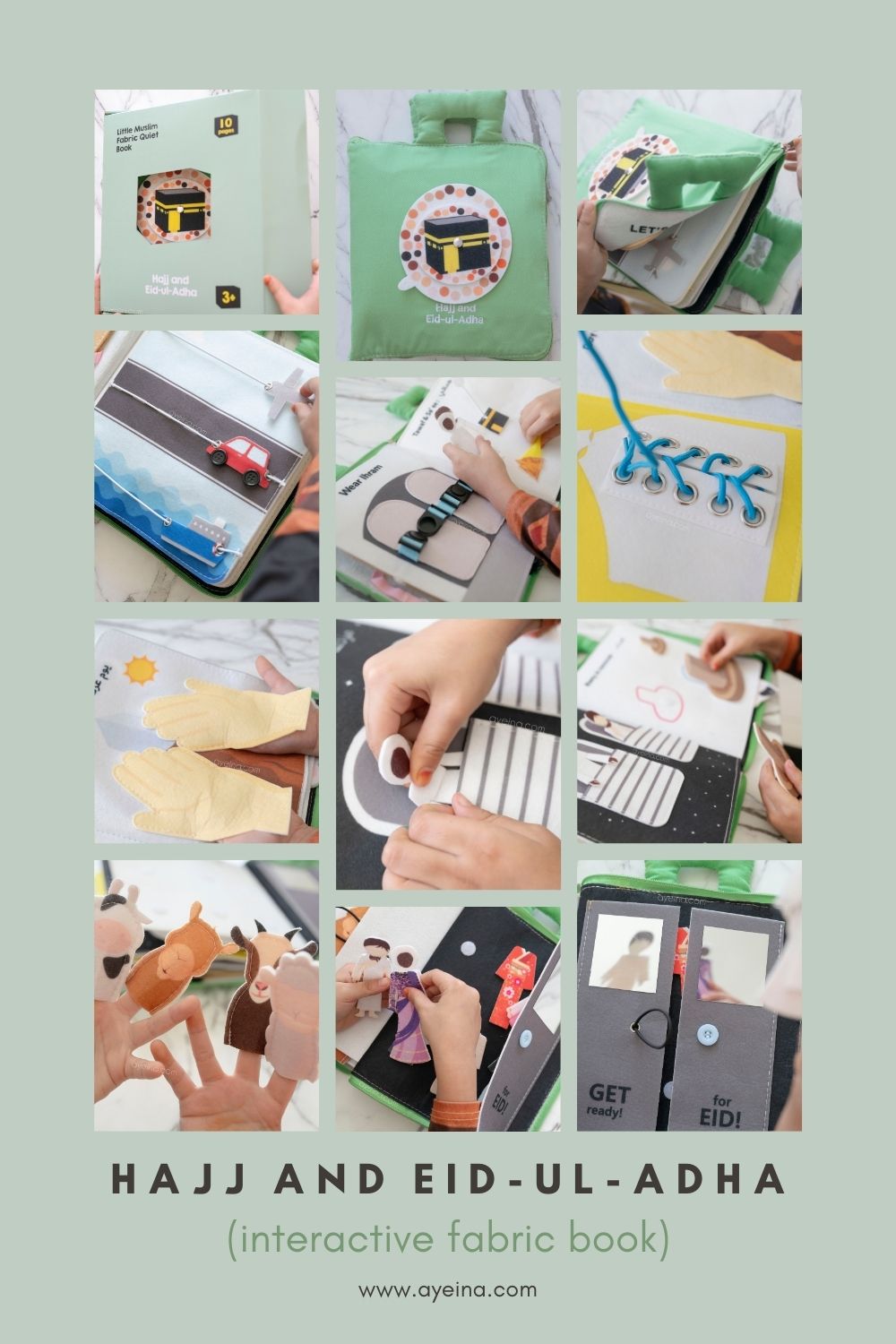
“Hajj and Eid-ul-Adha” interactive fabric book is a hands-on journey through the sacred rites of Hajj. It will help you introduce your little ones to the beautiful journey of Hajj with this captivating 10-page interactive fabric book designed especially for Muslim children. Through touch, movement, and imaginative play, kids experience the story, rituals, and spirit of Hajj and Eid al-Adha. Every page is crafted to spark curiosity and bring the pilgrimage to life through sensory-rich learning.
It is ideal for helping little ones practice and improve their fine motor skills, hand-eye coordination, and sensory processing through interactive play. Let your child learn through visual stimulation and tactile sensation with the help of velcro, fidgets, buckles, buttons, zips, brads, hooks, etc. Some of the skills your little one will practise include lacing, looping, size-matching, counting, imaginative play through finger puppets, dressing-up, and more. There are 10 interactive pages encouraging fun, hands-on learning of animals, cultures, modes of transport, sizes, and so much more. The book measures 10″ high x 8″ wide. A great Islamic learning tool for any preschool parent.
It comes with a padded handle which provides portability for quiet and focused time anywhere at home or for keeping little ones quietly entertained as a travel companion. It’s perfect for keeping kids busy while learning on car journeys, plane rides, train journeys, on the bus, at the airport or station, during khutbah at the masjid, at weddings, and in waiting rooms. It fully zips up (through a double-sided zip) to close for easy storage of small parts.
RRP (each): £ 25 GBP / $ 33 USD
See the STORIES on Instagram for a more in-depth look. This interactive Hajj quiet book was thoughtfully designed to help children experience the pilgrimage with their hands, their senses, and their imagination. Below is a deeper look into each page and the learning opportunities it brings spiritually, emotionally, and developmentally – starting with the basic steps of Hajj in sequence and ending with the celebration of Eid:
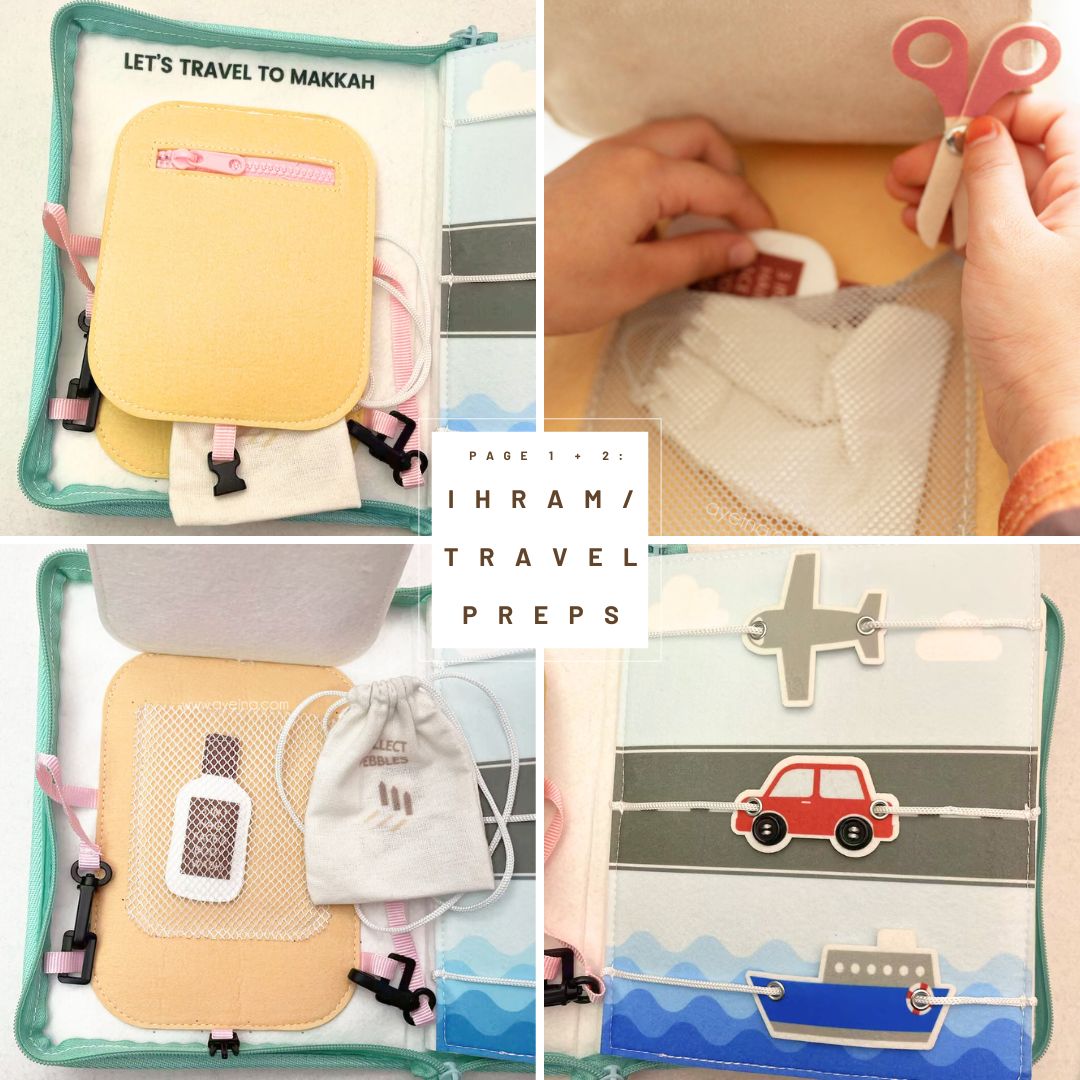
Ihram/Hajj preparations
Before children even “begin” their Hajj journey, they are introduced to the concept of getting ready – a huge part of the actual pilgrimage.
A fabric bag with two different types of fasteners, snap hooks and a clip buckle, strengthens fine motor skills while also introducing children to real-life closures they’ll encounter.
Inside the mesh bag (for texture exploration), children find:
- A felt scissor to practice the symbolic haircut performed after sacrifice.
- A puffy bottle for pretend hair, face, and body wash – a playful way to teach the sunnah of cleaning oneself with unscented products while in ihram.
- A pebble pouch for collecting stones for the Jamarāt – familiarizing them with one of the more active rituals of Hajj.
Traveling to Makkah
Children learn that pilgrims travel from every corner of the world – some by plane, some by car, and some by ship.
Each mode includes tactile, movable pieces:
- Plane wings
- A car with button-wheels
- A ship rocking on waves
Parents can use the opportunity to point to maps, talk about where their own families come from, or explain how millions of Muslims gather together in one sacred place through different modes of transport.
Muhrim (travel) Safety
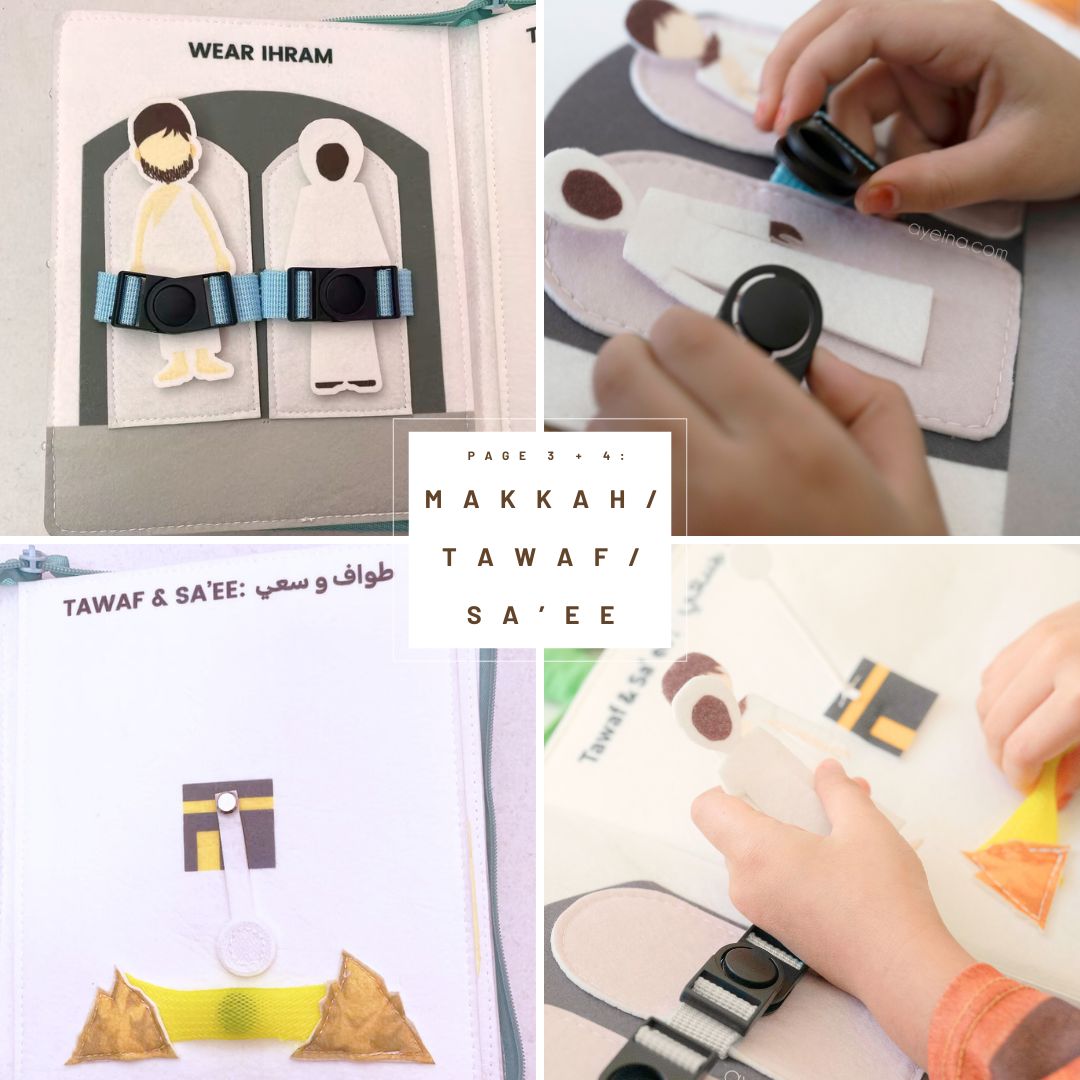
Before even arriving in Makkah, children engage with two seat-belted muhrims – one male in ihram, one female. Fastening and unfastening seat belts teaches safety during travel, focus and hand strength. It’s also a natural way to talk about the etiquettes of traveling in Islam – making dua, saying Bismillah, and behaving patiently.
Tawaf and Sa’ee
Kids can place muhrims on velcro around the Ka’bah and move them 7 times one by one – practicing counting and sequencing. A child can be taught to say “labbaik Allahumma labbaik” while making the muhrim do Tawaf/Umrah. The lower half of the page shows Safa and Marwa mountains between which a small marble can be moved to and fro inside a mesh fidget for Sa’ee. Parents can narrate the story of Hajar behind Sa’ee alongside. This page enhances counting skills and fine motor coordination while teaching core pillars of Hajj while also teaching emotional regulation through repetitive movement.
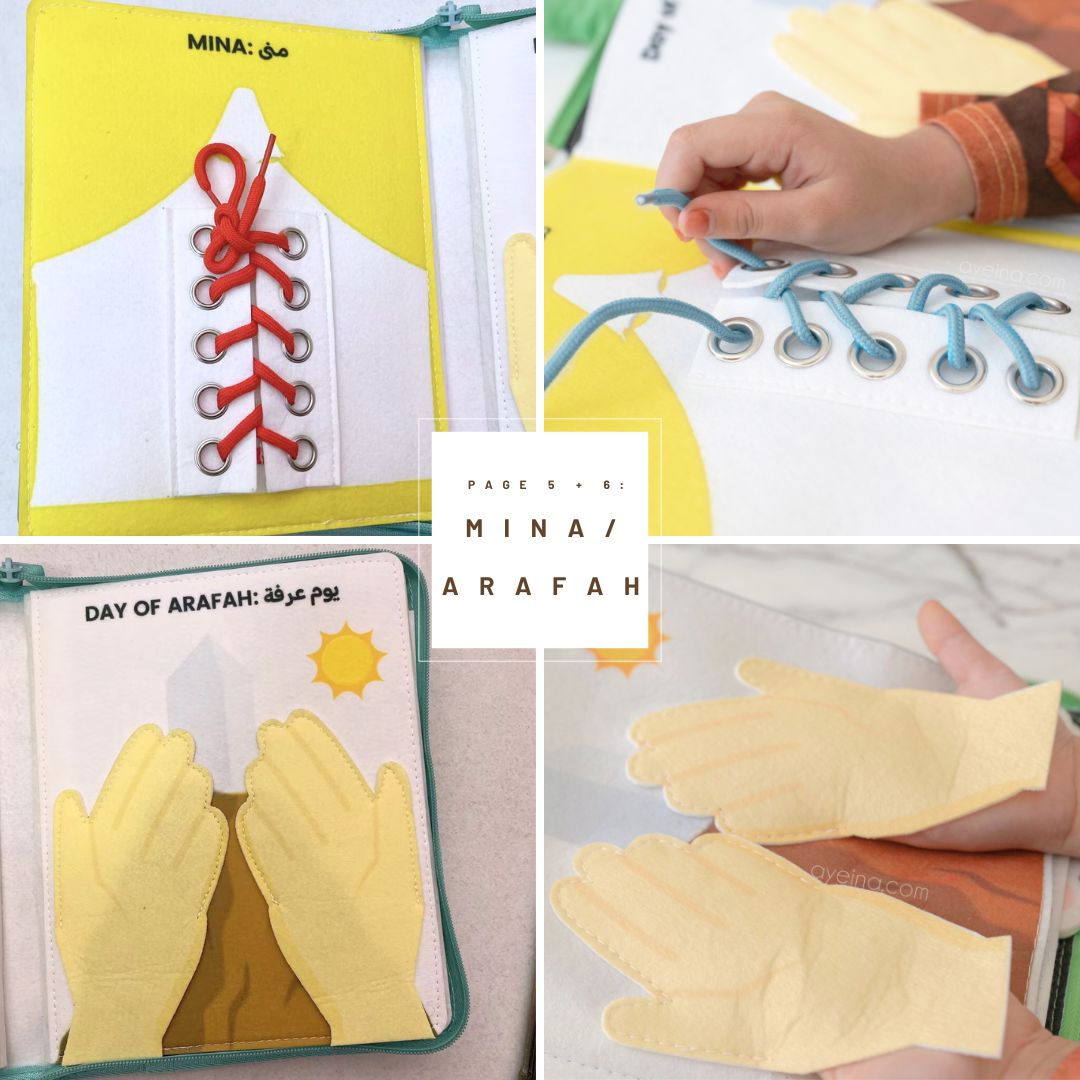
Mina
The Mina page uses laces that children open and close, practicing important hand skills. When the tents open, the muhrims can rest inside, just as pilgrims spend nights in Mina before the Day of Arafah. This page is perfect for teaching children the value of community as millions of pilgrims stay in tents together – women and children in one big tent and men in another.
Arafah
Soft dua hands act like mittens, helping children learn left and right while teaching them how Prophet ﷺ used to raise hands in a dua. Parents can encourage children to say small duas here for oneself, parents, siblings, friends, and the ummah at large.
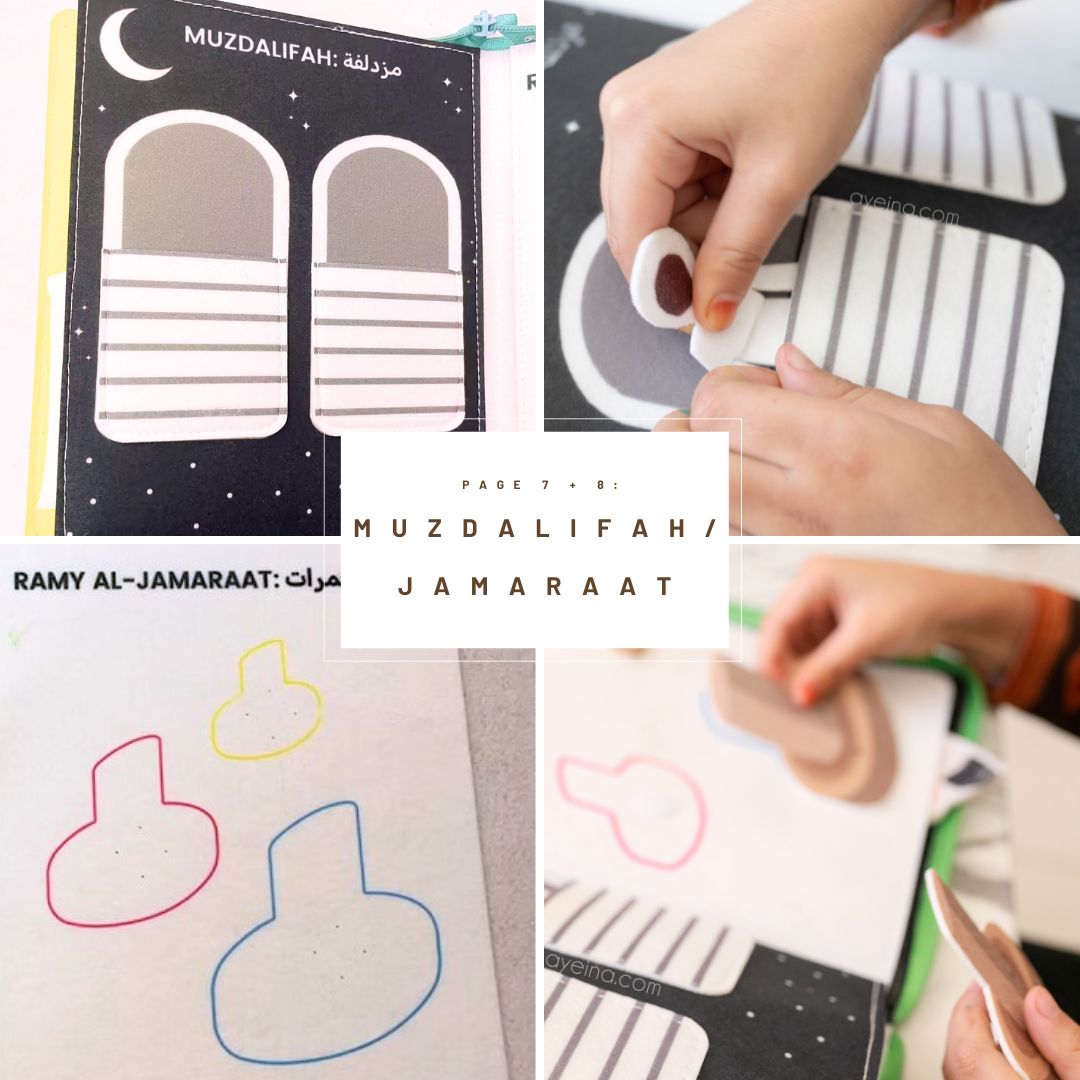
Muzdalifah
Children tuck their muhrims into two cozy sleeping bags under the night sky of Muzdalifah. This page introduces spending the night outdoors and collecting stones (preparing for the day ahead). It also creates a beautiful moment to talk about simple-living and how we will all be gathered in front of Allah in the aakhirah in an open land as well.
Jamaraat
Three fabric Jamarāt pillars in different sizes help children practice sorting, size-comparison, and counting. Using the pebble pouch from page 1, children can learn the symbolic act of resisting Shaitan. It’s a wonderful place to teach about making good choices that please Allah.
Udhiya – Sacrifice
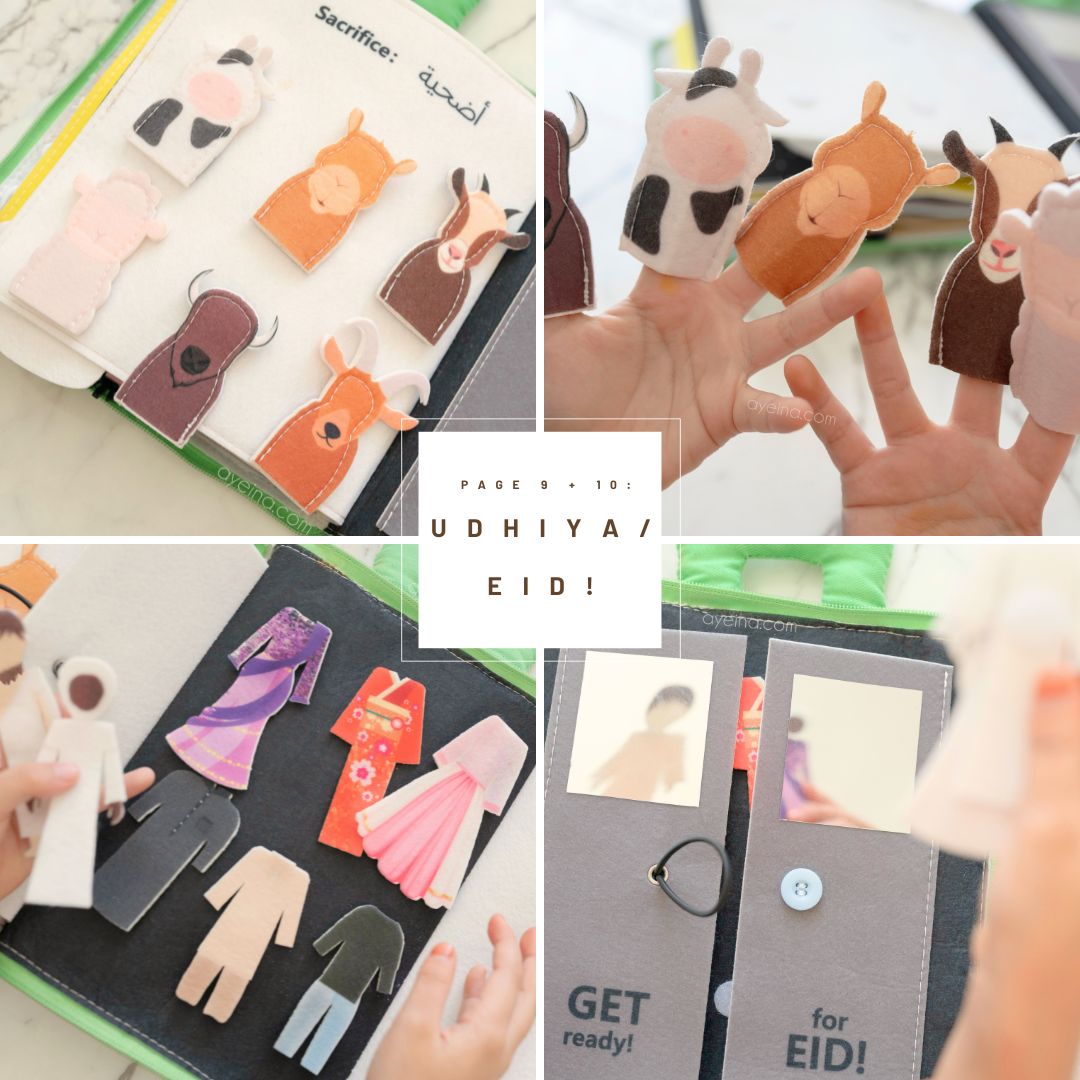
Six finger-puppet animals (cow, camel, sheep, goat, ram, and bull) allow kids to role-play the importance of sacrifice while learning about charity and gratitude. Parents can use this page to start conversations about why Muslims sacrifice during Eid, the story of Ibrahim عليه السلام and Ismail عليه السلام, sharing (by feeding others), and the global ummah’s Eid traditions.
Eid!
Muhrims can try out 6 traditional outfits (or commonly worn Eid clothes) from around the world – representing cultures across Asia, Africa, Europe, and the Arab world. Muhrims can see their final look in the mirror in front of the closet that loops with a button. Children can learn diversity within the Muslim ummah through this page and how Hajj ends with celebration and unity.